 SLPcentral
Speech therapy progress report: a template and 3 examples from your data
A template, and three examples built from one made-up student’s data: on track, slow progress and goal met.

A speech therapy progress report tells parents, in plain words and real numbers, how a student is doing on each IEP goal: where they started, where they are now, under what conditions and with how much support, and whether they’re on track to meet the goal by the end of the IEP. The fastest way to write one is to start from the session data for the reporting period, not from memory. Below is a template and three examples built from one made-up student’s data: on track, slow progress and goal met.
In short: for each goal, give the date range, the baseline, the most recent data (a few points, not one good day), the cue level and conditions, and a plain-language judgment of progress. Accuracy goals get percentages with the trials behind them; frequency goals get counts. Say what the numbers don’t show. Your district’s form and progress codes come first.
What does IDEA require in a progress report?

IDEA’s rule on IEP content, 34 CFR §300.320(a)(3) (opens in a new tab), says each IEP has to describe how the student’s progress toward the annual goals will be measured and when periodic progress reports will be provided, for example quarterly or at the same time as report cards. So the IEP itself sets your schedule and your measure. ASHA’s page on documentation in schools (opens in a new tab) adds that progress reports should include both quantitative and qualitative information, so parents can follow progress toward the goals.
IDEA doesn’t give you a form. Districts and states do, often with progress codes such as “making sufficient progress” or “goal met.” Use your district’s form and codes; the examples below show what goes in the narrative.
How do you turn a date range of data into a narrative?
- Pull the data for the reporting period only. List the date range and how many times the goal was measured.
- Compare the start with the recent end. Baseline (or the first data point of the period) against the last two or three data points. One great session isn’t a trend, and neither is one bad one.
- Report in the goal’s own measure. Accuracy goals: percent correct, with the trials behind it. Frequency goals: the count. Never convert one into the other.
- Name the support and the conditions. Cue level, activity, materials, group or individual. “70% independently in single words” and “70% with moderate cues in conversation” are different students.
- Say what the numbers can’t. Carryover to the classroom, teacher or parent reports, attendance gaps. Include them only if you actually have them, and say where they came from.
- Give the judgment, then the next step. On track, slower than expected, or met, and what you’ll do next. Goal changes are an IEP team decision, so the report can recommend a conversation, not make the change.
The data behind the examples
Leo is a made-up third grader with three goals. Each goal was probed every one to two weeks this quarter. Accuracy probes were 10 trials without feedback.
| /r/ initial, words (accuracy, independent) | “Why” questions (accuracy, up to moderate cues) | Peer initiations (count, independent) | |
|---|---|---|---|
| Aug 20 (baseline) | 3/10 (30%) | 4/10 (40%) | 2 |
| Sep 3 | 4/10 (40%) | 5/10 (50%) | 3 |
| Sep 17 | 5/10 (50%) | 4/10 (40%) | 3 |
| Oct 1 | 5/10 (50%) | 4/10 (40%) | 3 |
| Oct 8 | 6/10 (60%) | 5/10 (50%) | 4 |
| Oct 15 | 7/10 (70%) | 4/10 (40%) | 5 |
| Oct 22 | 7/10 (70%) | 5/10 (50%) | 4 |
Clinician notes for the period (also made up): /r/ probes used picture cards in the speech room. “Why” questions were asked about a grade-level story read aloud in a small group, and most of Leo’s correct answers needed a moderate cue, a choice of two answers, with 0 to 2 independent per probe. (With a choice of two, some correct answers can be guesses, so watch the independent number too.) His initiations were counted during a 30-minute structured game with two peers, and prompted initiations were tallied separately. He attended 18 of 20 scheduled sessions.
Example 1: on track
Goal: Leo will produce /r/ in the initial position of words with 80% accuracy, independently, on 3 consecutive probes. Progress: Leo is making progress toward this goal. From August 20 to October 22, his independent accuracy producing /r/ at the beginning of single words rose from 30% (3/10 trials) at baseline to 70% (7/10) on each of the last two probes. Probes used picture cards in the speech room, without feedback. If this rate continues, he is on track to meet the goal by the end of the IEP year; the criterion is 80% on 3 consecutive probes, so the next probes will show when he reaches it. Next, we will keep practicing words and begin short phrases once he reaches the criterion. His /r/ in classroom conversation was not measured this period.
Example 2: slow progress
Goal: Leo will answer “why” questions about a grade-level story with 80% accuracy, given no more than moderate cues. Progress: Leo is making limited progress toward this goal. Across seven probes from August 20 to October 22, his accuracy answering “why” questions about a story read aloud in a small group stayed between 40% and 50% (most recently 5/10, 50%), compared with 40% at baseline. Most correct answers needed a moderate cue, a choice of two answers; 0 to 2 per probe were independent. Next period, I will add a visual story map to sessions and compare the data. If progress stays limited, I will bring the data to the IEP team to discuss next steps.
A slow-progress report is where a narrative earns its keep. It doesn’t hide the flat line, it says what support the student needs, and it names a concrete change to try. It doesn’t decide on its own to change the goal or the services.
Example 3: goal met
Goal: Leo will initiate a comment or question to a peer at least 4 times during a 30-minute structured activity, on 3 consecutive probes. Progress: Leo has met this goal. He initiated a comment or question to a peer 4, 5 and 4 times on the last three probes (October 8, 15 and 22), up from 2 at baseline. These counts are independent initiations during a structured game with two peers; initiations after a prompt were tallied separately and not counted. The IEP team may want to consider a next goal, such as initiating in less structured settings.
Notice that the met goal has no percentage. Leo’s goal counts initiations, so the report gives counts. “Leo initiated with 80% accuracy” would invent a denominator that was never recorded.
Free speech therapy progress report template
One block per goal. Copy it into your district’s form, or use it to draft the narrative before you open the IEP system.
| What to write | |
|---|---|
| Goal | The goal as written in the IEP, including its measure and criterion |
| Reporting period | Start and end dates; how many times the goal was measured; attendance if it affected the data |
| Baseline → recent | Baseline or first data point, then the last two or three data points, in the goal’s own measure |
| Support and conditions | Cue level; activity and materials; group or individual; setting |
| Beyond the numbers | Classroom carryover, teacher or parent reports, only if you have them, credited to the source |
| Progress and next step | Your district’s progress code, one plain sentence of judgment, and what you will do next |
Can an app draft a progress report from your data?
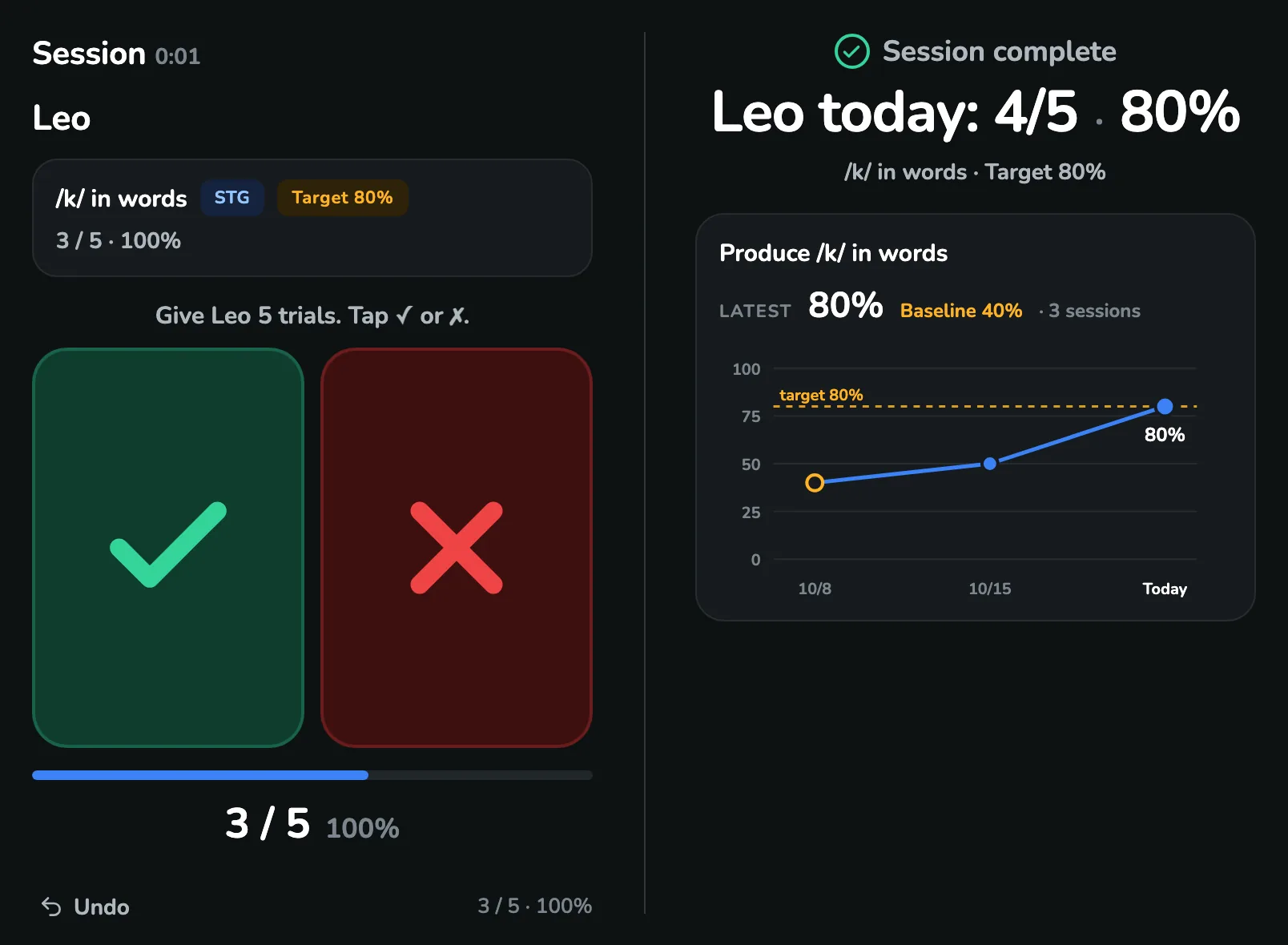
Full disclosure: I built SLPcentral, and drafting progress reports from real session data is the reason it exists, so weigh this section accordingly. You take data in the app during sessions (✓ or ✗ per trial, a cue level when a response needed support, or a count for frequency goals). When reports are due, you pick the reporting period, see exactly which goal data will be used, and Ollie, the app’s AI assistant, drafts a progress narrative for each goal from that data, with a suggested progress code in your district’s wording; you choose the code. The draft is labeled as a draft. You check every number against the graph, add what only you know, and save it yourself. Licensed SLPs can start a 14-day free trial, then it’s $19.99 a month or $149.99 a year (pricing).
Reports stand on the data you took all quarter, so the habits matter more than the tool. The SLP SOAP note examples show the session notes those numbers come from. Present levels set the starting point those reports measure from; see speech PLAAFP examples. More about Ollie is in Meet Ollie.
Frequently asked questions
What should a speech therapy progress report include?
For each IEP goal: the reporting period, the baseline, the most recent data in the goal’s own measure, the cue level and conditions, anything the numbers don’t show (only if you have it), and a plain judgment of progress with the next step. Use your district’s form and progress codes.
How often are IEP progress reports required for speech therapy?
As often as the IEP says. Under IDEA (34 CFR 300.320(a)(3)), each IEP describes how progress will be measured and when periodic reports will go out, for example quarterly or with report cards. Your district sets the schedule.
How do I write a progress report when a student isn’t making progress?
Report the flat data honestly in the goal’s measure, describe the support the student needed, name a specific change you will try, and say you will bring the data to the IEP team if progress stays limited. Changes to goals or services are the team’s decision.
Should a progress report give percentages for every goal?
No. Accuracy goals get a percentage with the trials behind it. Frequency goals get a count, because there is no denominator. Converting a count into a percentage invents data.
Can AI write a speech therapy progress report?
AI can draft one from your data, but you’re responsible for it. Check every number against your records, add what only you know, and keep identifying information out of tools your district hasn’t approved.
Sources
- IDEA regulations, 34 CFR §300.320(a)(3) (opens in a new tab) (the IEP describes how progress toward annual goals is measured and when periodic reports are provided)
- ASHA Practice Portal, Documentation in Schools (opens in a new tab) (progress reports with qualitative and quantitative information; the IEP sets how and when progress is reported)
- ASHA Practice Portal, Documentation in Health Care (opens in a new tab) (what progress notes include in health-care settings)
- ASHA, AI Considerations for CSD Professionals (opens in a new tab) (review AI-assisted documentation)
Drafted with AI help from the sources listed, then reviewed and edited by Ryan Lillard. Students in examples are fictional. This article is general information, not legal advice; follow your district’s forms and procedures. Ollie is an AI assistant; he drafts, you decide.