 SLPcentral
SLP SOAP note examples (school and outpatient), with a free template
Four worked examples, each shown next to the session data it came from, plus a template you can copy.

An SLP SOAP note documents one therapy session in four parts: Subjective (what you observed and what was reported to you), Objective (the measurable data, such as trials correct out of total and the cue level), Assessment (what that data means for the goal) and Plan (what happens next). Below are four worked examples, a school articulation session, a three-student group, a frequency goal and an outpatient pediatric session, each shown next to the made-up data it came from, plus a free template you can copy.
In short: every number in the Objective section should trace back to your data. Accuracy goals get correct out of total; frequency goals get a count, never a percentage. Record the cue level each response needed. Write one note per student, even after a group. SOAP is common in health care, but schools vary, so use the format your district requires.
Hi, I’m Ryan, an SLP grad student and the founder of SLPcentral. The students below (Maya, Jonah, Ella and Leo) are made up, and so is every number.
What goes in each part of an SLP SOAP note?

ASHA’s page on documentation in health care (opens in a new tab) describes SOAP as a commonly used format for showing the skilled service you provided and the need for continued services. ASHA spells out the A as Analysis; many SLPs say Assessment. It’s the same section. ASHA’s page on documentation in schools (opens in a new tab) doesn’t prescribe one format, because school systems set their own. Check with your district.
- S, Subjective: how the student arrived and engaged, and anything reported to you, such as a teacher’s comment or a parent’s report of home practice. Say who reported it (“Teacher reported…”) rather than stating it as fact.
- O, Objective: the goal, the activity, the data (correct out of total and the percentage for accuracy goals; a count for frequency goals), the cue level, and the conditions, such as individual or group and minutes.
- A, Assessment: your interpretation: how today compares with baseline or recent sessions, what helped, what got in the way. This is where your clinical judgment goes.
- P, Plan: your next step: continue, fade a cue, move from words to phrases. Changes to goals, services or dismissal are IEP team decisions, not session-note decisions.
Example 1: an individual articulation session (school)
The data (made up). Maya, 2nd grade, 30-minute individual session. Goal: produce /s/ in the initial position of words with 80% accuracy, independently, across 3 consecutive sessions. Activity: picture-card drill, 20 trials. Independent: 15 correct, 3 incorrect (all /θ/ for /s/, “thun” for “sun”). On the other 2 trials she got a minimal visual cue (a model of tongue placement) and was correct both times. Independent accuracy in the last two sessions: 60% and 70%. Her teacher mentioned at drop-off that Maya has been raising her hand more in reading group.
- S: Maya participated in a 30-minute individual session. Her teacher reported that she has been raising her hand more often in reading group.
- O: During a picture-card drill, Maya produced /s/ in the initial position of words with 75% accuracy independently (15/20 trials). With a minimal visual cue for tongue placement on 2 trials, accuracy was 85% (17/20). All 3 errors were /θ/ substitutions.
- A: Independent accuracy has risen over the last three sessions (60%, 70%, 75%) and is approaching the 80% criterion. Errors were consistent interdental placement, and she was correct on both trials where a visual cue was given.
- P: Continue /s/ in the initial position of words, reducing visual cues. Probe /s/ in short phrases once she meets the word-level criterion.
Notice what isn’t there: no “good session,” no percentage that isn’t in the data, and the teacher’s comment is credited to the teacher. Both numbers (75% independent, 85% with support) are true. The goal says “independently,” so the Assessment compares the 75% with the criterion.
Example 2: a three-student mixed group (school)
After a group, each student gets their own note. The activity line can be shared; the data, cue levels and assessment can’t. Here is one 30-minute group with three different goals.
| Goal | Data | Result | |
|---|---|---|---|
| Jonah | Answers “wh-” questions about a short story, 80% accuracy | 10 trials: 5 correct independently. On the other 5 he got a moderate cue (a choice of two answers): 2 correct, 3 incorrect. Needed 1 redirection back to the game. | 50% independent; 70% with cues |
| Ella | Produces /r/ in the initial position of words, 80% accuracy | 10 trials: 6 correct, all independent | 60% |
| Leo | Follows 2-step directions, 80% accuracy | 10 trials: 6 correct independently. On the other 4 he got a minimal gestural cue: 1 correct, 3 incorrect. | 60% independent; 70% with cues |
Here is Jonah’s note. Ella’s and Leo’s share the activity line and have their own data and assessment.
- S: Jonah participated in a 30-minute group session with two peers. He needed one redirection to return to the game.
- O: During a story-based board game, Jonah answered “wh-” questions about a short story with 50% accuracy independently (5/10 trials). With moderate cues (a choice of two answers), he answered 2 more correctly, for 70% (7/10).
- A: Jonah is below the 80% criterion. He answered 2 of the 5 cued trials correctly, so a choice of two didn’t reliably help, and the support may need to change.
- P: Continue “wh-” questions in group. Try re-reading the story sentence that holds the answer, or a visual support, before offering a choice of two.
Two checks after any group: every student’s note shows their own numbers, and minutes are per student. If Leo left 10 minutes early, his note says 20 minutes.
Example 3: a frequency goal (a count, not a percentage)
The data (made up). Leo, 30-minute group session with two peers. Goal: initiate a comment or question to a peer at least 4 times during a structured activity, in 3 consecutive sessions; only independent initiations count. Tally: 3 initiations on his own, plus 2 after a verbal prompt (“Ask Ella what she picked”). Independent initiations in the last two sessions: 2 and 3. He stayed with the card game for the whole session.
- S: Leo joined the group card game and stayed with the activity for the full session.
- O: During a structured card game, Leo initiated a comment or question to a peer 3 times independently and 2 more times after a verbal prompt (5 in total).
- A: Independent initiations were 2, 3 and 3 over the last three sessions, below the criterion of 4. He initiated after a verbal prompt on 2 more occasions.
- P: Continue structured peer games. Replace the verbal prompt with an expectant pause first, and prompt only if he doesn’t initiate.
What not to write: “Leo initiated with 60% accuracy.” A frequency goal has no denominator, so there’s nothing to divide by. A percentage needs defined opportunities (for example, “responds to 80% of peer greetings”), and that makes it an accuracy goal. Also decide ahead of time whether prompted initiations count toward the criterion. This goal counts only independent ones, so the note reports the prompted ones separately.
Example 4: an outpatient pediatric session
Outpatient and private-practice notes usually carry more detail. ASHA’s health-care documentation page (opens in a new tab) lists the patient’s response, the service delivery model, progress compared with prior sessions and the skilled services you provided, and says to document total treatment time when timed codes are billed. Payer and clinic rules vary, including whether diagnosis and billing codes go in the note, so check yours. From January 1, 2027, 92507 is replaced by timed codes split by disorder area, so minutes per area matter more; see the new speech therapy treatment codes, explained.
The data (made up). Ella, age 4, 45-minute individual session in the clinic, mother present. Goal: produce final consonants in CVC words with 80% accuracy given minimal cues, to improve intelligibility. Treatment: minimal pairs (“bee” and “beet”, “toe” and “toad”) and a visual cue, a finger tap marking the final sound. 30 picture-naming trials: 15 correct independently. On the other 15 she got the minimal cue: 6 correct, 9 incorrect (final consonant deleted). Last session: 60% with minimal cues. Mother reported practicing the home picture cards on 4 of the last 7 days. The clinician modeled final-sound emphasis during a shared book, and the mother practiced it 3 times with feedback. Next visit: one week.
- S: Ella attended with her mother, who reported practicing the home picture cards on 4 of the last 7 days.
- O: In a 45-minute individual session, Ella produced final consonants in CVC words during picture naming with 70% accuracy given minimal visual cues as needed (21/30 trials), and 50% independently (15/30). Errors were final consonant deletions. The clinician used minimal pairs and a visual cue marking the final sound, and modeled final-sound emphasis during shared book reading; her mother practiced the strategy 3 times with feedback.
- A: Accuracy with minimal cues rose from 60% last session to 70%, below the 80% goal. Half of all trials (15/30) were correct without a cue, and 6 of the 15 cued trials were correct. She is not yet independent, so continued skilled intervention is indicated to improve intelligibility. Caregiver training on the book-reading strategy was provided, and home practice is ongoing.
- P: Continue final consonants in CVC words with minimal pairs and fade the visual cue. Mother to use the book-reading strategy at home. Next visit in one week.
Free SLP SOAP note template
Copy this into your own notes, or print the page. Fill each line from your data, not from memory, and use your district’s or clinic’s form if it has one.
| What to write | |
|---|---|
| Header | Date, session length, individual or group, setting, and the student identifier your setting uses |
| S, Subjective | How the student arrived and engaged; anything reported, credited to whoever said it |
| O, Objective | For each goal: the activity, the data (accuracy: correct / total and %; frequency: the count), the cue level and the conditions |
| A, Assessment | Compared with baseline or recent sessions; what helped; what got in the way |
| P, Plan | Next session’s focus and any change in cues or difficulty |
What are the most common SOAP note mistakes?
- A percentage on a frequency goal, or a count with an invented denominator.
- A cue level that isn’t in the data, like “with minimal cues” when every trial was independent.
- “Improved” with no earlier data to compare it with.
- Reports written as facts (“practiced at home”) instead of credited (“mother reported…”).
- Identical notes for every student after a group.
If you use AI to draft notes, the same checks apply, plus a privacy check. See Can SLPs use ChatGPT for SOAP notes? for what to keep out of a chatbot.
Can an app draft the SOAP note from your data?
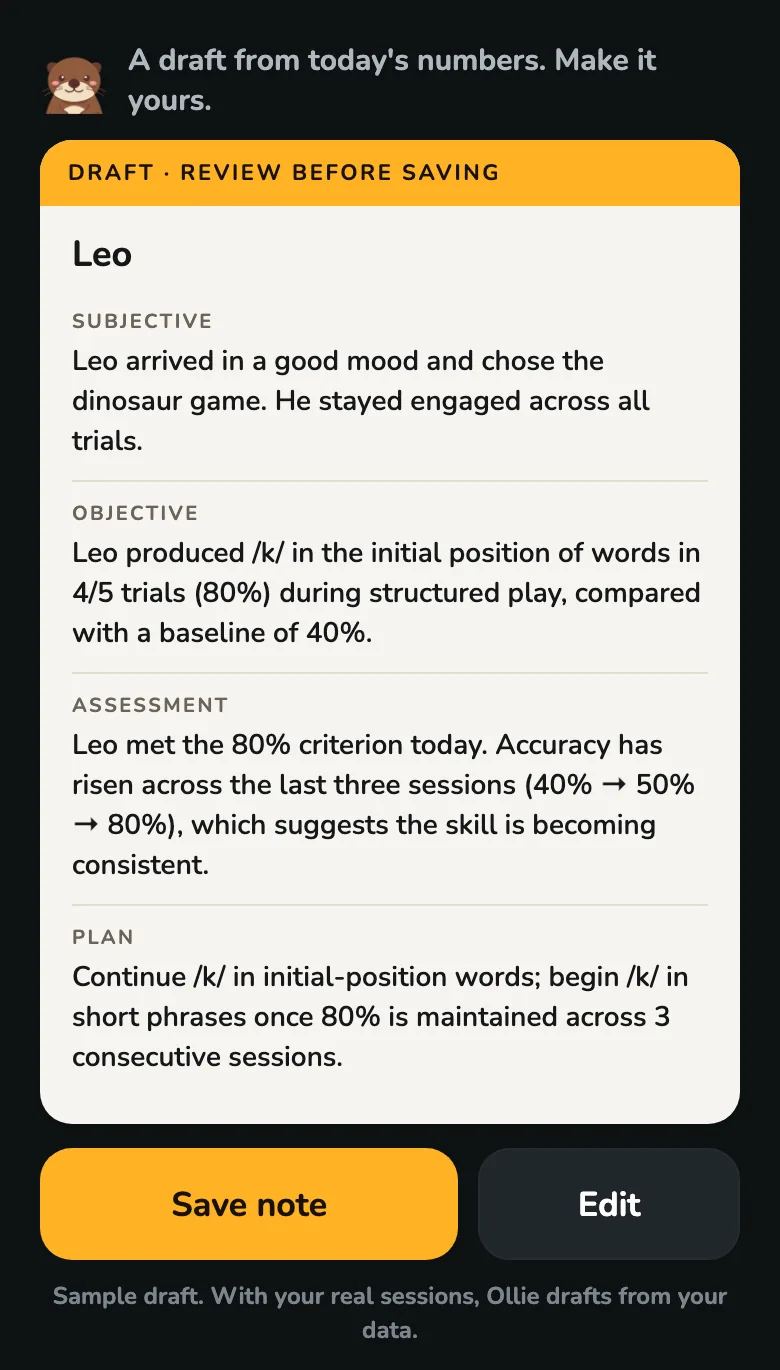
Full disclosure: I built SLPcentral, so weigh this with that in mind. In SLPcentral you tap ✓ or ✗ for each trial during the session, with a cue level when a response needed support, and accuracy and frequency goals are kept apart. Afterward, Ollie, the app’s AI assistant, can draft the SOAP note from those trials. The draft is labeled as a draft, and nothing goes into the client’s notes until you review it, edit it and tap Save. Licensed SLPs can start a 14-day free trial (pricing), and how the app handles privacy is in what to look for in an AI note taker.
Frequently asked questions
What is a SOAP note in speech therapy?
A SOAP note documents one therapy session in four parts: Subjective, Objective, Assessment and Plan. ASHA describes SOAP as a format commonly used in health care. School districts set their own documentation formats, so check what yours requires.
What goes in the objective section of an SLP SOAP note?
The measurable data: the goal, the activity, correct out of total trials and the percentage for accuracy goals, the count for frequency goals, the cue level, and conditions such as group or individual and minutes.
Do school SLPs have to write SOAP notes?
Not necessarily. ASHA doesn’t prescribe one documentation format for schools, and districts vary. Many school SLPs use SOAP or a district template. Use whatever your district requires.
How do you write a SOAP note for group speech therapy?
Write one note per student. The activity description can be shared, but each student’s data, cue levels, minutes and assessment are their own.
Can AI write SOAP notes for speech therapy?
AI can draft a SOAP note, but you’re responsible for it. Check every number against your data, check cue levels and anything the draft added, and keep identifying information out of tools your district or employer hasn’t approved.
Sources
- ASHA Practice Portal, Documentation in Health Care (opens in a new tab) (SOAP format; what treatment notes and progress notes include; treatment time for timed codes)
- ASHA Practice Portal, Documentation in Schools (opens in a new tab) (no single required format; what school treatment notes include)
- ASHA, AI Considerations for CSD Professionals (opens in a new tab) (review AI-assisted documentation)
Drafted with AI help from the sources listed, then reviewed and edited by Ryan Lillard. Students in examples are fictional. Follow your district’s or clinic’s documentation requirements. Ollie is an AI assistant; he drafts, you decide.