 SLPcentral
Free tools for SLP grad students (2026): what’s worth using
Evidence, the 400 clock hours, data and notes in placement, Praxis prep. Mostly free, from a current SLP grad student.

Grad school in speech-language pathology is a strange mix of very expensive and very broke. You’re paying tuition, buying test-prep books, driving to placements, and then someone suggests a $30-a-month app. No thanks.
I’m an SLP grad student myself, so this list is the one I’d hand a friend starting their first semester. It’s organized by the job you’re trying to get done, and it’s mostly free. Where something costs money, I say so, and I say why it might still be worth it. One of the tools is mine, and I’ll flag it clearly when we get there.
One rule before anything else: your program and your placement sites decide which tools you can use with client information. Many sites have their own systems and don’t allow outside apps for anything identifying. Ask your clinical supervisor before you put client data anywhere.
1. Finding and reading the evidence
**ASHA Practice Portal (opens in a new tab) (free).** This is the place to start for almost any clinical topic: what a disorder is, assessment, treatment, and documentation. It’s written for practicing clinicians, it’s public, and it’s the source your professors and supervisors already trust. The professional-issues pages on documentation in schools (opens in a new tab) and in health care (opens in a new tab) are worth reading before your first placement.
**ASHA Evidence Maps (opens in a new tab) (free).** Searchable summaries of research by topic, including systematic reviews and clinical practice guidelines. They’re useful when you need to justify a treatment choice in a paper or a lesson plan and don’t know where to begin.
PubMed and Google Scholar (free), plus your university library. Search in PubMed or Scholar, then get the full text through your library login. Learn your library’s proxy link early; it saves hours.
**NSSLHA membership (opens in a new tab) ($60, not free).** National NSSLHA membership is $60 through December 31, 2027. It includes access to ASHA’s journals, and if you join for your last two years of grad school, NSSLHA says you save up to $250 on your initial ASHA membership and certification fees. If you join for your final two years, the savings can outweigh the $60. Check the current terms on their site.
2. Tracking your clinical clock hours
Under ASHA’s 2020 certification standards (opens in a new tab), you need 400 clock hours of supervised clinical experience: 25 hours of guided clinical observation and 375 hours of direct client contact. At least 325 of the 400 have to be completed while you’re in your graduate program, and, if you started grad school on or after January 1, 2023, at least 250 must be on-site, in-person direct contact (earlier cohorts have a different rule). Up to 75 hours can come from clinical simulation, at your program’s discretion. Your practicum also has to include people across the life span, from various cultural and linguistic backgrounds, and with various types and severities of communication disorders. ASHA doesn’t set a minimum number of hours per disorder area, which is why it helps to see where your hours are thin.
ASHA has published new certification standards (opens in a new tab) that take effect August 1, 2027, and they change some of these rules (guided observation, for example, becomes optional). If you’ll finish after that date, ask your program which standards apply to you (link in Sources).
Your program’s system comes first. Many programs use CALIPSO, where you submit hours for supervisor approval. Its site says 86% of SLP programs use it. If your program uses it, you’ll pay a one-time student fee ($125 for SLP students, per CALIPSO’s pricing page (opens in a new tab)), and your program pays an annual fee. You don’t get to choose this one, and you shouldn’t try to replace it. Your hours are official where your program says they are.
Keep a personal backup anyway (free). A simple spreadsheet works: date, site, supervisor, minutes, observation vs. direct, disorder area, age range. Update it the same day. When a supervisor is slow to approve or a site changes systems mid-semester, you’ll be glad you did. It also shows you at a glance which disorder areas still have gaps.
3. Data and notes in placement
This is where grad students lose the most time: tallying trials on paper, computing percentages, rewriting notes your supervisor marks up.
Printable data sheets (free). A good sheet has a column per trial, a place for the cue level, and room for one observation per student. Ask your supervisor for theirs first so your data matches what the site expects.
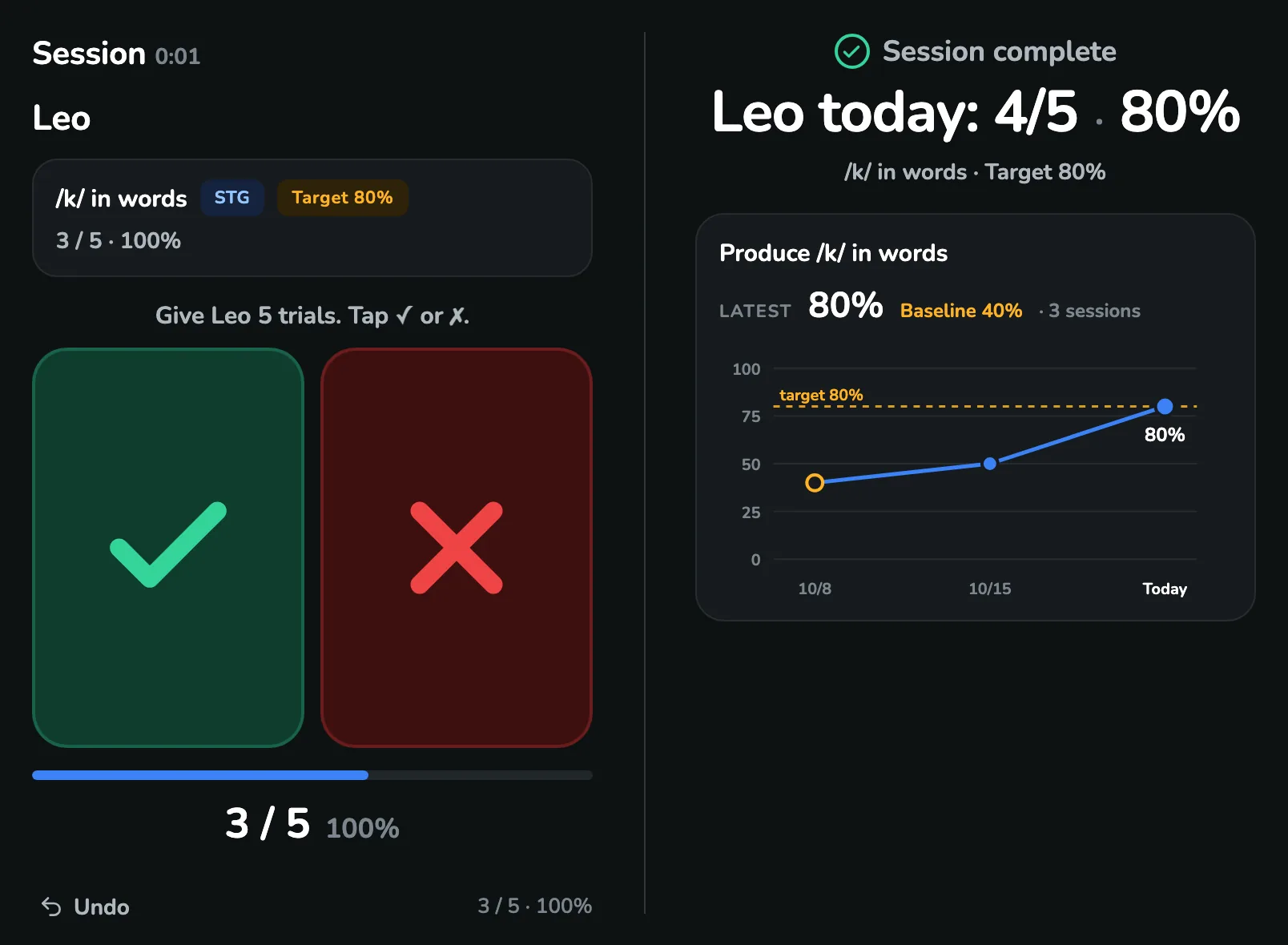
SLPcentral’s free grad toolkit (free; I built it). Full disclosure: this one is mine. SLPcentral is an iPhone and web app for SLPs, and grad students get the clinical tools free, with no trial countdown and no card:
- a caseload of up to 10 clients
- IEP goals with targets
- live session data: one tap per trial, with cue levels and groups
- progress graphs that build themselves
- session notes
- your 400 hours tracked by ASHA disorder area
Grad accounts also get 15 free AI drafts a month (they come back on the 1st), so you can try having Ollie, the app’s AI assistant, draft a note or progress report from your logged data, plus a limited number of Ollie messages a day. The AI sees a code like CLT_X92J instead of the client names you’ve saved, and names stay on your device unless you turn on encrypted name sync. A name you type into a note can still reach the AI, so keep names out of free text. Even so, the rule above applies: use it with client information only if your placement allows it. It’s also fine for practicing on mock cases in class.
Don’t let any app draft your clinical reasoning for you. Your supervisor is grading how you think, and the skill you’re building is turning data into a sound clinical judgment. Use the data and the drafts as a starting point. Then rewrite until every sentence is something you’d defend. Your notes still need your supervisor’s review and signature; an AI draft doesn’t change that.
4. Praxis prep
**ETS free resources (opens in a new tab) (free).** ETS’s page for the Speech-Language Pathology test (5331) offers the official Study Companion and Study Plan for free, and its prep bundles include an official free practice test. Start there before you buy anything. The Study Companion lays out the content categories, so you can see where you’re weak.
Paid options, if you need them. ETS sells interactive practice tests and a prep course. Third-party books and courses exist too. Try the free official material first, then spend money only on the categories where you’re struggling.
5. Ethics, AI and professional basics
**ASHA Code of Ethics (opens in a new tab) (free).** Read it once properly, not just the summary slide. It asks clinicians to evaluate the effectiveness of the technology they use, and ASHA’s AI guidance ties evaluating technology to the Code, which matters as AI tools show up in class and clinic.
**ASHA’s generative AI guidance (opens in a new tab) (free).** Before you paste anything about a client into ChatGPT for a lesson plan or a report, read ASHA’s AI pages. The short version: keep identifying information out of AI tools unless your organization has vetted the tool, and check AI output carefully. Your program may also have its own AI policy for coursework.
A chronological age calculator (free). You’ll calculate chronological age constantly for standardized tests, and test manuals don’t all handle rounding the same way. Do it by hand until you understand it, then use a calculator to check yourself. SLPcentral has one built in, and it shows the exact years;months;days without rounding, so you can apply your test manual’s rule.
What I’d actually set up in week one
- Bookmark the ASHA Practice Portal and set up your library’s proxy link.
- Start your personal hours backup the day you log your first observation hour.
- Get your supervisor’s data sheet, or set up a free app if your site allows it.
- Download the free ETS Study Companion so you know what the Praxis covers before your courses do.
- Read ASHA’s AI guidance before your first paper that tempts you to use ChatGPT.
Frequently asked questions
How many clinical hours does an SLP grad student need?
Under ASHA’s 2020 standards, 400 clock hours of supervised clinical experience: 25 guided observation hours and 375 direct client contact hours, with at least 325 completed during your graduate program. New standards take effect August 1, 2027, so confirm with your program which standards apply to you.
What’s a free way to track SLP clinical hours?
Log them in your program’s official system (often CALIPSO), and keep a personal backup in a spreadsheet or free app with the date, site, supervisor, minutes, hour type and disorder area. SLPcentral’s grad toolkit tracks all 400 hours by ASHA disorder area at no cost.
Do I have to pay for CALIPSO?
If your program uses it, CALIPSO lists a one-time student fee ($125 for SLP students) and an annual fee paid by the program. Your program chooses the system.
Are there free Praxis study materials for speech-language pathology?
Yes. ETS offers the official Study Companion and Study Plan for the Speech-Language Pathology test (5331) for free, plus an official free practice test.
Can grad students use apps with client information in placement?
Only if your program and placement site allow it. Many sites require their own systems. Ask your clinical supervisor first, and never put identifying client information into a general AI tool.
Sources
- ASHA, 2020 Standards for the Certificate of Clinical Competence in Speech-Language Pathology (opens in a new tab)
- ASHA, 2027 SLP Certification Standards (opens in a new tab)
- ASHA Practice Portal (opens in a new tab)
- ASHA Evidence Maps (opens in a new tab)
- NSSLHA, Membership (opens in a new tab)
- CALIPSO, Pricing (opens in a new tab) and home page (opens in a new tab)
- ETS, Praxis Speech-Language Pathology (5331) (opens in a new tab)
- ASHA, Code of Ethics (opens in a new tab)
- ASHA, Generative Artificial Intelligence for Clinicians (opens in a new tab)
Prices and fees checked October 26, 2026. They change, so check each site.
Drafted with AI help from the sources listed, then reviewed and edited by Ryan Lillard. Students in examples are fictional. This article is general information, not legal advice; follow your program’s and placement’s policies. Ollie is an AI assistant; he drafts, you decide.